Top Signs You Need Garage Door Service – Don’t Ignore These
Most garage door failures announce themselves weeks in advance, and almost nobody is watching. A door doesn’t snap a spring out of nowhere – the cable was already fraying, the bottom seal was already uneven, or the door had been taking two seconds longer to open than it did six months ago. The breakdown is just the last event in a sequence. Here’s what to watch for, and when it’s time to stop watching and call someone.
Start With Your Eyes, Not Your Ears
Homeowners are trained to hear the door. We’d rather you look at it. Noise gets all the attention, but the physical condition of cables, rollers, seals and springs tells you far more, and it tells you earlier. A door can sound completely normal while a cable is down to its last few strands.
Open the door to about eye level and take a slow look at these four things:
- Cables. A healthy cable is a tight, uniform braid with no stray wires. A degraded cable has broken strands sticking out like a frayed rope, or visible rust along its length. Fraying means it’s holding less load than it’s supposed to every single time the door moves.
- Rollers. Look at the roller wheels along the track. Normal wear is even and flat on the rolling surface. A flat spot, a wheel that won’t turn, or a grooved wear pattern on one side only points to a door that’s tracking crooked.
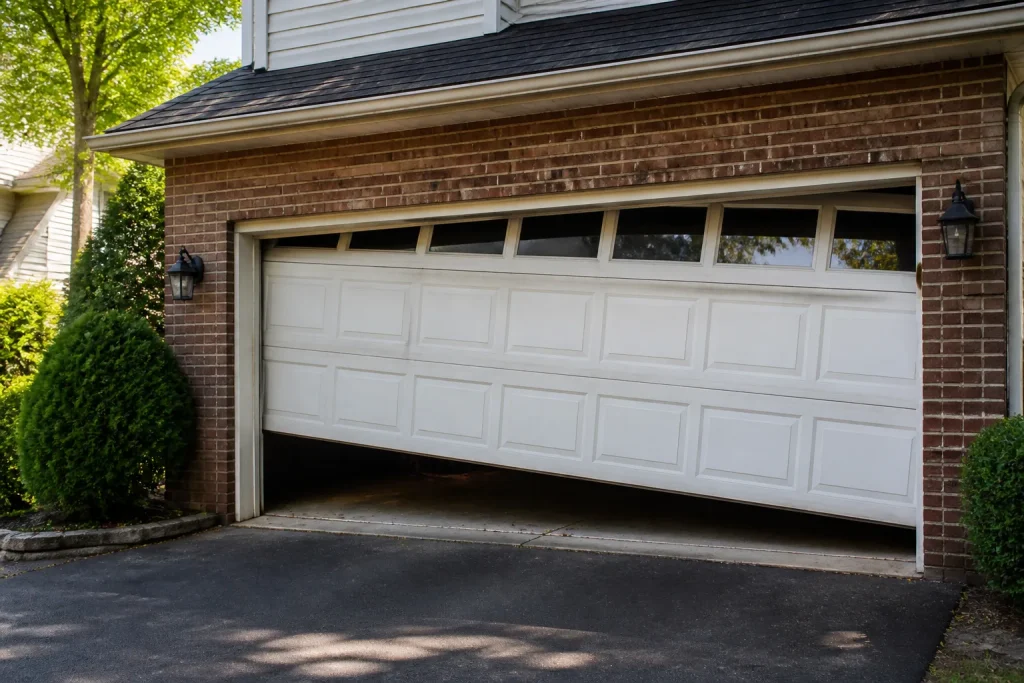
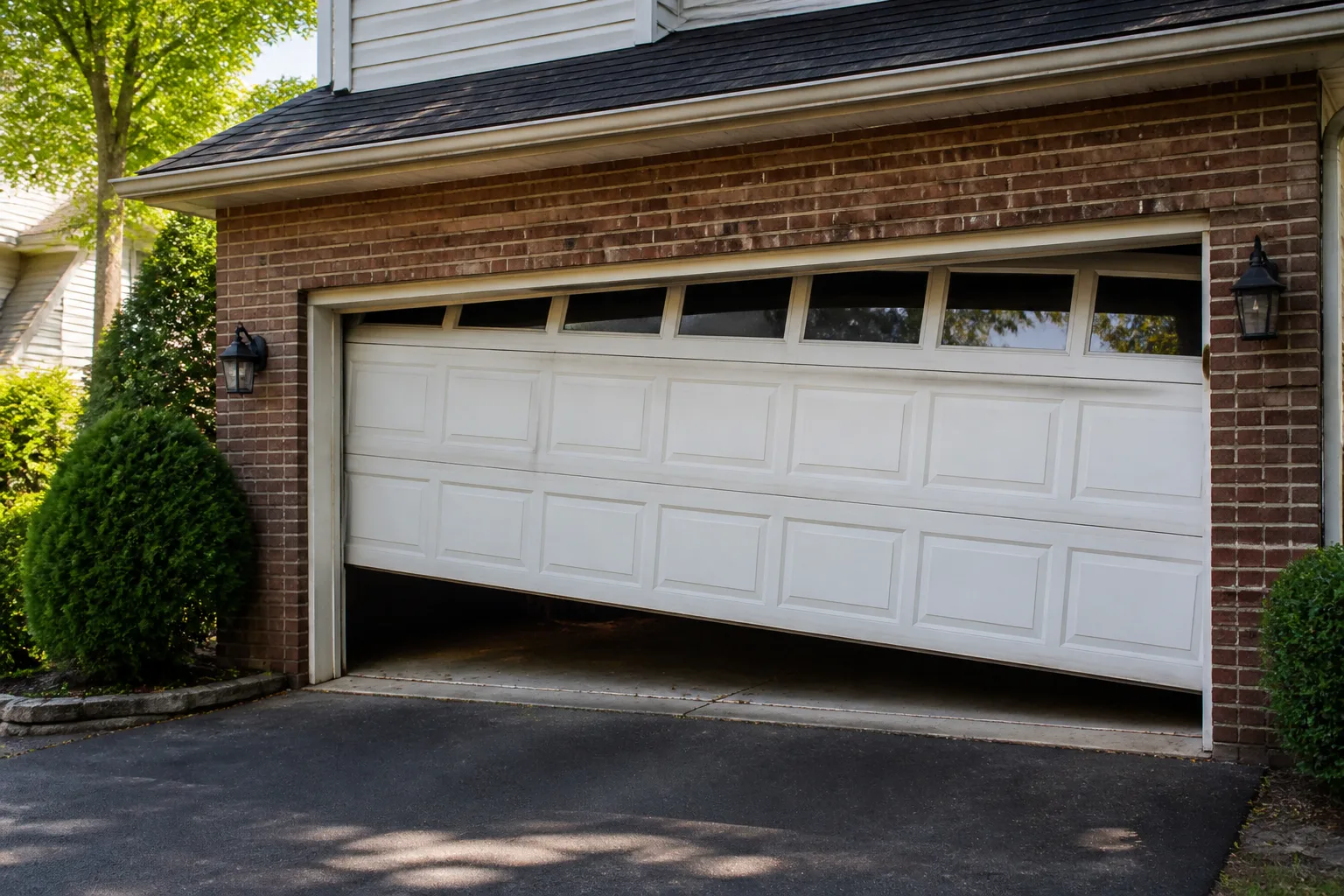
- Bottom seal. The rubber seal should sit flat and touch the floor across the full width. An asymmetrical gap on one side, or daylight you can see under the door, means the door is out of level or the seal has torn.
- Springs. Rust on a torsion or extension spring is a real warning. Surface discoloration is common, but heavy pitting or flakes mean the spring is losing material and moving closer to failure.
This is a five-minute inspection. Do it a couple of times a year and you’ll spot problems while they’re still cheap to fix. If what you see is frayed cables or heavily rusted springs, don’t touch anything further – call us at (855) 337-1686 and we’ll take it from there.
Operational Symptoms That Point to Early Failure
Alongside the visual check, watch how the door behaves. Early failure signals show up in how the door operates more than in how it sounds. Here in Stamford, where winters swing between freezing and thawing, those symptoms tend to show up fast once they start.
What to watch for:
- Speed changes. If the door opens slower than it used to, especially on the first open of a cold morning, that’s a flag. A door that’s working but moving slowly is often more urgent than a door that’s making noise – slow travel usually means the springs are fatigued and close to giving out.
- Path deviation. Watch the door as it goes up. It should move in a straight, steady line. A door that drifts side to side, binds at one point, or stalls and then lurches is telling you the track, rollers or springs are out of balance.
- Balance asymmetry. Stand to the side and watch the top panel as it rises. If one side climbs faster than the other, one spring is working harder than its partner. That’s a two-spring door acting like a one-spring door, and the uneven load wears everything faster.
- New noises. Grinding means metal-on-metal, usually rollers or a dry bearing. A sharp pop is often a spring catching. Rattle means loose hardware. None of these get better on their own.
- Opener strain. If the opener sounds like it’s struggling, the door itself is probably the problem, not the motor. It’s common for homeowners to call us about garage door opener repair when the opener is fine and the springs are finished.
The Balance Test: What Your Springs Are Actually Doing
Here’s the one test worth learning, because it separates a healthy door from a tired one before anything breaks. It’s the balance test, and it takes about a minute. Disconnect the opener first – most openers have a pull rope or release handle for exactly this – so the door is moving on springs alone. Lift the door to about waist height and let go.
A properly balanced door will hold roughly where you leave it, or drift down slowly and evenly. A door whose springs have lost tension will drop fast or fall hard. One that won’t stay up at all is running almost entirely on the opener, and the springs are near the end of their life.
What the result tells you:
- Holds in position, drifts slowly: springs are still calibrated. You’re in good shape.
- Drops quickly or slams down: the springs have lost tension. This is a “call now” result.
- Rises on its own, or feels unusually heavy to lift: springs are over- or under-tensioned, and the door is out of balance.
That test is the whole point of checking your door mid-cycle. If your door fails it, don’t try to adjust the tension yourself. Garage door springs are under extreme tension, and a slip can cause serious injury. That’s a job for a trained technician, and it’s why garage door spring repair is a dedicated service for us rather than a side note. Call (855) 337-1686 for a free estimate.
Why Stamford’s Late Winter Is Peak Failure Season
Timing matters here, and it’s the thing most homeowners miss. Spring and cable failures in Stamford cluster in late winter and early spring. The reason is simple physics. A garage door spring is a piece of steel under constant tension, and steel behaves differently when it’s cold. When temperatures swing between a hard freeze and a mild thaw, the metal expands and contracts, and every cycle works the spring that little bit more than a stable temperature would.
That’s why a door that was fine all fall suddenly breaks on the first cold snap of February. A pre-season check in early February is worth scheduling for exactly that reason. It’s cheap insurance against a door that fails when you need it most, on a morning when your car is trapped inside and the school run is twenty minutes away.
Doors that see heavy use – the family car out and back several times a day – wear faster than a door that gets a few cycles a week. If your door gets used constantly or if it has some serious age on it, a check before the cold sets in beats a repair after it. Clopay and Amarr doors are common in Stamford homes, and we work on both. Either way, the principle holds: check in February, not in April when something’s already broken.
When to Call a Pro (And When Not To)
Some garage door fixes are safe to do yourself, and some absolutely are not. It helps to know the line, because a door that’s working fine with one loose bolt is a ten-minute fix, while a door with a tired spring is a trap for the unprepared.
Safe to handle yourself: wiping down and lubricating hinges, rollers and tracks; checking that the safety sensors at the floor are aligned and the lens is clean; tightening a loose bracket or bolt; replacing a weather seal.
Call a professional for: anything involving torsion or extension springs, cables, drums or the counterweight system, and any door that’s out of balance, off its track, or won’t stay closed. High-tension components can cause serious injury – this is the one part of garage door work to leave to a trained technician, every time.
On the opener side, a lot of “my opener is dying” calls turn out to be a misprogrammed remote or a sensor knocked a few degrees off, so it’s fair to check the simple things first. But if the opener itself is grinding, jumping, or the door only moves partway, that’s a repair call. We’re fluent across the main opener platforms – the Wi-Fi-connected ones from LiftMaster and Chamberlain’s myQ line and Genie’s Aladdin, plus traditional systems – and we diagnose by the brand in your garage rather than guessing. A garage door repair visit can cover springs, openers, panels and tracks in one trip. For a failing door that’s left your home exposed or your car trapped, call (855) 337-1686 and we’ll get a technician out.
The Bottom Line
Your garage door is your home’s largest moving part, and it warns you before it fails. The warning is in what you can see and how it moves: frayed cables, flat-spotted rollers, an uneven bottom seal, rust on a spring, a slower open, a door that drifts off its path or won’t hold its balance. None of those require a diagnostic tool. They require five minutes and a little attention, ideally before the February cold sets in.
If your check turns up any of those signs, or your door already fails the balance test, that’s your cue. In our experience, the door that’s been slow to open and slightly off-balance for a few weeks is usually the one that’s about to break – not the noisy one. Our technicians have up to 13 years of experience, and we work on the brand already in your garage: eight manufacturer lines from LiftMaster and Chamberlain through Genie, Clopay, Amarr, Wayne Dalton, Craftsman and Raynor, plus same-day and emergency service when a door has already let you down.
If you’re in Stamford and need help, Stamford Garage Door Repair Pros offers free estimates – call (855) 337-1686. We’ll tell you what you’re looking at, what it costs, and what to do next. That’s the whole conversation. Stamford Garage Door Repair Pros
Frequently Asked Questions
Watch for four things: frayed cables, flat-spotted rollers, an uneven bottom seal, and a door that opens slower or drifts off its straight path. If any of those show up, or your door fails the balance test by slamming down when you lift it to waist height and let go, it needs service. In Stamford, get the door checked before late winter, when temperature swings put the most stress on springs and cables. Call (855) 337-1686 for a free estimate.
Rust or pitting on the spring, a door that opens more slowly than it used to, one side of the door rising faster than the other, and a door that won’t hold its balance when lifted by hand. A door that drops fast is already running on a tired spring. Springs are under extreme tension and can cause serious injury, so any of these signs means a call to a trained technician rather than a DIY fix. Call (855) 337-1686 and we’ll take a look.
Early February, before the late-winter thaw and freeze cycle works the steel in your springs and cables hardest. A quick visual check of cables, rollers, seal and springs plus a balance test takes a few minutes and catches problems while they’re still small. Call (855) 337-1686 to schedule a free estimate.
Often, yes. A noisy door usually has a worn roller, a dry hinge or loose hardware – annoying, but not about to fail. A door that moves noticeably slower than it used to is usually showing spring fatigue, and that springs tend to break rather than fade. Where noise is a nuisance, slow travel is a countdown. Call (855) 337-1686 for a check before yours reaches zero.
Written by the team at Stamford Garage Door Repair Pros.
Need Garage Door Help?
Call Stamford Garage Door Repair Pros - the local pro we connect you with is licensed and insured, here with fast after-hours help in Stamford.
(855) 337-1686